Icons & Definitions
2PEAK uses the following icons to represent the single workouts within your training plan.
Workout Description

Training Duration and Intensity
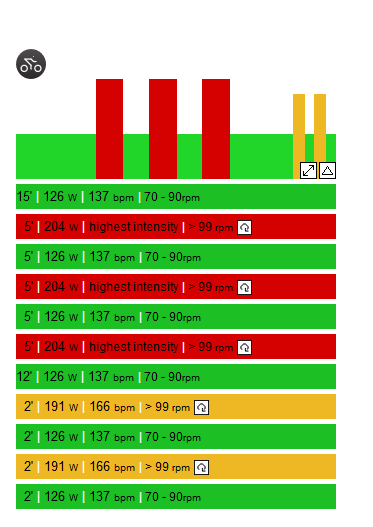
2PEAK shows the duration and intensity of the training in a bar diagram. Duration is always in time - not distance! The symbol to the left of the bar shows the sport discipline – in this case: cycling. Basic training is always in the basic endurance zone - Z2 (light green). Intervals at higher intensities are embedded in this light green bar. In this example the whole workout lasts for two hours. After a warmup, there are two intervals in Z4 (orange) then there are two more in Z5 (red).

Training details in the weekly plan
By clicking alongside the training bar in the weekly plan, you will be shown a detailed view. The icons under the training bar show the content of the training: in this case, uphill intervals and stretching after training. To the right, the intervals are shown as text.
Z2 means Basic Endurance - the basic training zone. Z4 means the Threshold zone and Z5 High Power zone.
20 minutes are shown as 20' and 20 seconds as 20”.
Workout schedule
By clicking directly on the training bar, you get a printable detailed view. Here you can see the exact time schedule and details such as the pedalling cadence (in cycling). The intensity is displayed as you prefer: as pulse frequency or power (in cycling) / speed (in running).

Z1, Recovery Zone (lowest intensity)
The Z1 training zone actively promotes recovery after hard efforts.

Z3, Upper Endurance Zone (medium to higher intensities)
Tempo-Training in Z3 improves your endurance and ability to maintain a high speed. This intensity is typical for long climbs and marathons. The intervals in Z3 are usually long (20 minutes shown here)

Z4, Threshold Zone
Training in Z4 raises the anaerobic threshold and improves your race specific endurance. Zone 4 training is always in interval form with repetition (20 minutes shown here).

Z5 Power Zone
In Z5 the intervals can last from a few seconds to several minutes (3 minutes shown here). In the very short maximum efforts, sprinting and acceleration ability is improved. It is important to perform these short intervals flat out, with full commitment.
Zone 5 efforts of over 1 minute should be performed as a time trial. Don't start long Z5 intervals at a sprint but more restrained, so that you can maintain the effort for the duration of the interval.
Recovery between Intervals
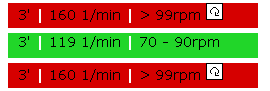
The length of the recovery between the intervals can be seen in the detailed view: three minutes in Z2 with a cadence of 70 to 90 RPM
General Icons for Scheduling and Logging
2PEAK permits detailed scheduling and corrects the recovery index automatically, when rest days, travel days or or No Time for training is planned or logged. The effect these three icons have on the recovery index ist identical.

No time
Use this icon, if you have no time to train or if you want to plan a training free day.

Rest Day
2PEAK will plan rest days. Rest days allow your body to recover for the next planned efforts. You can also enter a rest day, when training has been scheduled but you couldn't carry it out because you didn't feel fit enough. If this is the case, you will need to correct your recovery index accordingly.

Travel Day
Enter travel days when you can't train with this icon.

Performance Test
This icon shows the ideal point for carrying out a performance test. These tests should be done at regular intervals. A test will replace any intervals which might be included in that day's schedule.
Sports and disciplines
2PEAK has the following basic sport disciplines: Running, Cycling, Triathlon and X-Country Skiing. These disciplines can be extended to other disciplines, according to the training package you chose.

Running
Running is offered as a self contained sport discipline and as part of the triathlon package but it may also be added as a supplement to other sport packages.

Long Run
If you choose a Long-Run (1:15 and longer) 2PEAK will calculate the ideal length for you, based on your previous longest duration runs and slowly build on it. But these runs will be reduced in case you cannot sustain additional load or are forced to reduce it. The build up is therefore a function of what you have proven to be able to "digest". Long-Runs never include any intensity above base endurance.

Trail Running
Trail Running is offered as a supplement to other disciplines. With regards to content it is corrersponding to running but it will allow to report your trail mileage specifically.

Orienteering
Orienteering is offered as a supplement to other disciplines. With regards to content it is corrersponding to running but it will allow to report your orienteering mileage specifically.

Alpine Speed Hiking
Alpine Speed Hiking (fast vertical walking/running in mountainous terrain) is offered as a supplement to other disciplines. With regards to content it is corresponding to running but it will allow to report your vertical speed running mileage specifically.

Cycling
Cycling is offered as a self contained sport discipline and as part of the triathlon package but it may also be added as a supplement to other sport packages.

Long Ride
If you choose a Long-Ride (2hrs and longer) 2PEAK will calculate the ideal length for you, based on your previous longest duration rides and slowly build on it. But these rides will be reduced in case you cannot sustain additional load or are forced to reduce it. The build up is therefore a function of what you have proven to be able to "digest". Long-Rides never include any intensity above base endurance.

Mountain Biking
Mountain Biking corresponds to running with regards to content but it will allow to report your vertical speed running mileage specifically.

Spinning
Spinning may be added as a supplement to the Cycling package. The intensity will be automatically adapted to the shorter volume.

X-Country Skiing
X-Country Skiing ( both classic and skating technique) is offered as a self contained sport discipline. In order to prepare for XC ski races, you need to switch to a proper XC ski plan. Please contact support if you need assistance.

Roller Skiing
With Roller Ski we mean all alternative "dry-land" disciplines which allow you to train without snow. In order to prepare for XC ski races, you need to switch to a proper XC ski plan. Please contact support if you need assistance.

Swimming
Swimming is a part of the Triathlon package, it may be added as a multi sport option to other packages.
2PEAK chooses
This option is only available for triathletes. It is used by 2PEAK to determine your "deficient discipline" meaning the sport in which compared to wahr you trained and the season is ideally chosen. And no, you cannot select just two disciplines, since we always pick the biggest deficit out of all 3 disciplines.

Inline Skating
Inline Skating is offered as a supplement to other disciplines. It will allow to report your inline mileage specifically.

Yoga/Pilates
Yoga or Pilates is offered as a supplement to other disciplines.

Ski Touring
Back Country Ski Touring is offered as a supplement to other disciplines. It will allow to report your ski touring efforts specifically.

SUP
Stand Up Paddling is offered as a supplement to other disciplines.

Snow Shoeing
Snow Shoeing is offered as a supplement to other disciplines.
Ice Skating
Ice Skating is offered as a supplement to other disciplines.

Nordic Walking
Nordic Walking is offered as a supplement to other disciplines.

Other Sport Disciplines
This title is used for ball sports and other disciplines, which are not specifically recognized.

Strength Training
Strength training is incorporated in all training packages.

Stretching
2PEAK recommends stretching after every workout.

Upper body strength training
When this icon appears, the upper body shall primarily be trained.

Circuit Training (Strength Endurance)
Gym circuit with few exercise stations (e.g. Knee bends, knee raise, leg stretches) and immediate sport specific implementation after each lap. The exercises are carried out with low weight and 30-40 repetitions without break between stations. Implementation is carried out on the static bicycle or treadmill at Z2 or Z3 intensity. After the last lap there is at least 10 minutes on the static bike with a high cadence.
Example:10min Z2, cadence 90RPM warmup, then trunk strength training plus 4 laps of the circuit each followed by 3min static bike Z2-Z3 at 100RPM, trunk strength exercises and finally 10min cool down in Z2 at 90 - 100 RPM.

Circuit Training
This type of circuit training is different, in that it only uses the body's own weight. Strength endurance and Coordination should be mainly trained with simple exercises. Exercises such as pressups, static skipping with minimum ground contact, trunk training, stretch jumps... are just part of this type of exercise.
Example: 4-6 laps, at each station 30sec effort (6 repetitions) and 30sec recovery.
Cycling specific drills

Cadence oriented Training - Here you should ride in a low gear with a cadence of 100 to 120 RPM. High frequencies train your motor skills especially and also improve your pedaling efficiency.

Strength Oriented Training - When you see this symbol, you should ride in a high gear at a cadence of 50 to 70 RPM. Hilly or mountainous terrain is ideal for this.

Uphill training - If you don't include hills in your training, you will have problems when racing or riding marathons in hilly terrain. Hills should be ridden with a relaxed upper body and a bar top grip, or alternatively out of the saddle ("honking”). .

Skill Training Mastering the required skills very often brings a greater benefit than expensive material or "flat out riding". You should specifically work on your pedalling, cornering, braking and handling skills.

Uphill Sprint
This sprint exercise improves your max. strength and acceleration. It also brings into play your arm and trunk muscles. Ride out of the saddle in an all out effort on a four to eight percent gradient. (1 in 25 to 1 in 12)

Downhill Sprint
Takes advantage of the passive acceleration from the slope. Improves specifically your
top speed and max. cadence. The gradient boosts your motor
skill by spinning faster than your legs
normally could at a low pedalling power.
The ideal topography is a straight, open, traffic free slope of up to five percent (1 in 20).

Parabolic Sprint
This exercise is executed at the bottom of a valley, where the descent, where you accelerate to a high speed, reverses to a climb. Leave the chain on the big ring and try to maintain both the speed and the cadence as your legs start to hurt. This improves your lactate tolerance and mental strength. Mountain bikers profit from this on single trails and technical climbs while road racers are better able to handle strength sapping "counter-climbs" which often occur on long descents.